Introduction
Some wars do not happen on battlefields.
They happen behind closed doors—in homes filled with shouting instead of safety, silence instead of peace. They happen where children learn early how to listen for footsteps, how to read the mood of a room, how to disappear when love turns violent. These wars leave no headlines, no memorials, yet they create casualties all the same.
This piece is part of a series written to give voice to those often forgotten in conflict—the children who survive the fighting, only to inherit the aftermath. It is not written to shame, but to tell the truth. Not to accuse, but to name wounds that were never acknowledged.
This is the story of what remains after the war ends.
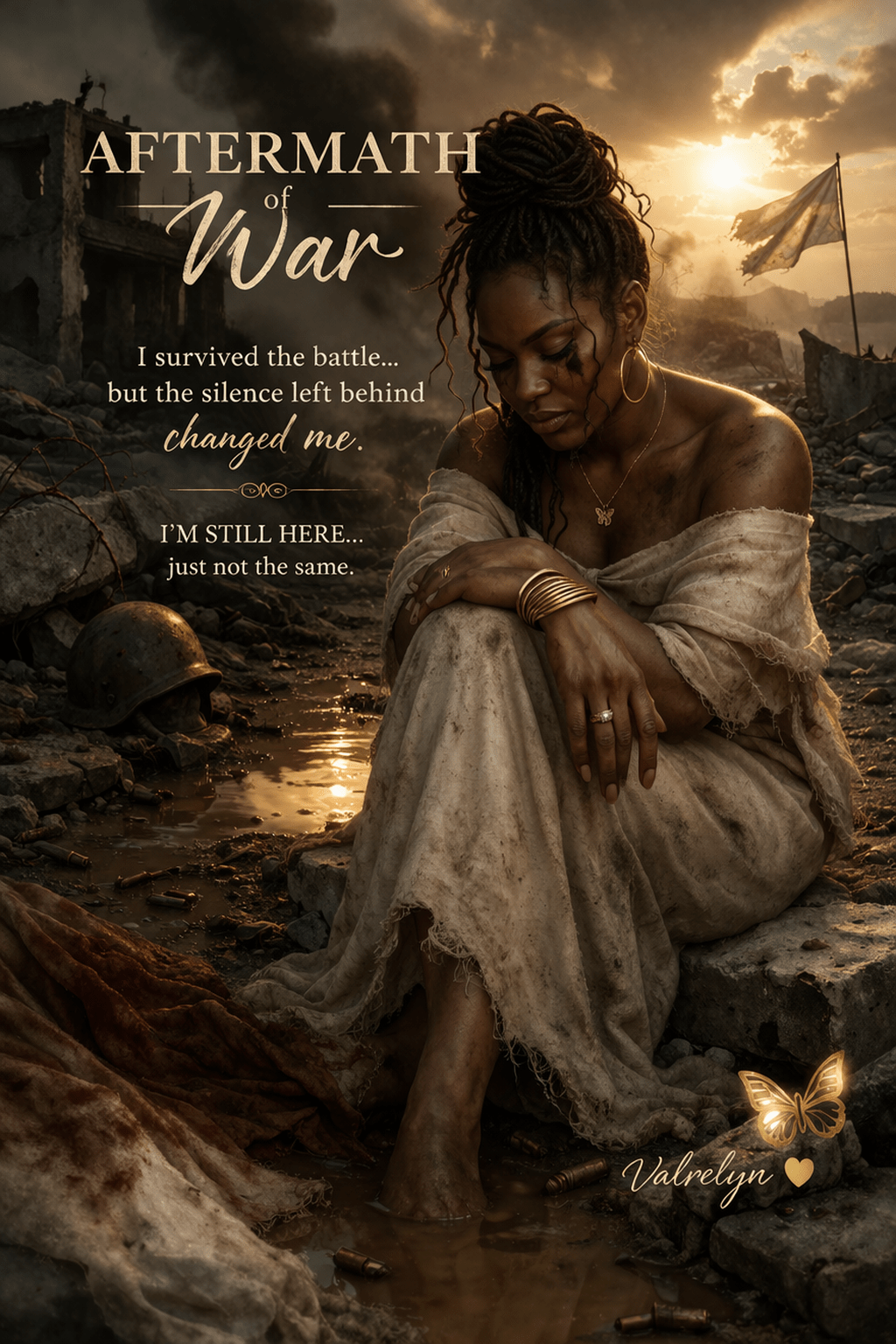
The Aftermath of War
How does one rebuild after a war, when the land is left desolate and stripped bare? How do you begin again when everywhere you look there are reminders of the battle you survived? War does not discriminate—it does not care how young or old its victims are. And when the casualties are children, how do you explain to them that they will be okay? That the reign of terror has ceased? That peace has come, even though the echoes of the battle still live inside them?
I am a silent victim of such a war.
Everyone talks about the parents’ story, but few ever ask about ours. I was there. I saw what happened behind closed doors. The screams that woke me in the middle of the night still linger in my memory. Even though one parent eventually left and life moved forward, the scars remained—etched slowly into my soul over years that felt endless.
We, the children, lived to tell the tale. We survived as prisoners of war inside our parents’ hostile marriage. Though we could finally breathe again and know we were safe, there was still a hidden story—unseen scars carried deep within our spirits. We were innocent bystanders forced into a land we should have never known.
As a child, I wondered why the parent I lived with stayed. Was it fear? Dependence? Denial? Parents often say they stay “for the children,” but I learned that wasn’t always true. Staying had a cost—and we were the ones who paid it. Watching abuse masquerade as love distorted everything I believed about relationships. I learned early to ask myself: Is this what love looks like? Is this what marriage is?
Yes, I was a victim. Like all victims, I longed for some sense of normalcy, yet I did not recognize my own worth. In the silence, I wondered if the chaos I witnessed was love—or if love was something meant for other people. I feared my future would mirror my past: marrying young to escape, seeking love in the wrong places, forever searching for what I never received.
Children in war become invisible. Our voices go unheard. We are used as pawns, punished for choosing sides, expected to perform happiness while living in terror. You learn how to lie well. You learn how to pretend. You become fluent in survival.
A child should never witness a parent striking another, or endure verbal cruelty disguised as discipline. That is not love. Children should never be weapons in a war between two adults. Parents may believe their children are unaware—but we hear the arguments, see the bruises, and feel the tension thick in the air. The damage is deeper than anyone realizes, and no amount of pretending can undo it.
Every insult hurled between parents became an assault on my own identity. When one parent degraded the other, it felt as though part of me was being torn down too. Slowly, worth eroded. Value diminished. And so many children step into adulthood carrying wounds they did not earn—some seeking escape through early marriage, others through endless relationships, all shaped by a war they never chose.
Imagine a war zone littered with rubble and frightened children. No shelter. No safe place to hide. In many ways, both parents became the enemy. Blame was passed back and forth, but the truth was unavoidable: the damage was shared. I walked through the debris trying to find peace, wondering if my existence itself was part of the problem.
As an adult, the questions followed me. Would I repeat their mistakes? Would I become bitter, angry, broken? Would I ever be free from the trauma buried beneath my skin? And where was God in all of this—why did He allow it?
It was there, in those questions, that I finally heard His voice.
This was not My desire for you, nor My perfect will. I gave your parents free will, as I have given you. But I know the end of your story. This war does not define you. You were never a mistake. I chose you because I knew you were strong enough to endure—and I will heal every broken place inside you.
He reminded me that I was seen, known, and deeply loved. That the scars were not permanent, and the war was not the end. Forgiveness was not excusing the harm—it was releasing myself from it. Healing required letting go of what had bound me.
And for the first time, I felt safe.
A Prayer for Healing After the War
Heavenly Father,
Thank You for protecting us in the midst of the war. Thank You for ending the battle and bringing peace to the land. We witnessed violence and sorrow, yet You shielded us from destruction we may never fully understand.
Heal every broken place within us. Renew our minds and teach us what real love is. Remove shame, guilt, and confusion. Let Your light penetrate the deepest wounds of our souls, leaving no darkness behind.
Help us forgive—not to forget, but to be free. Restore what was stolen. Teach us how to love well, and how to live whole.
Surround us with Your peace, and remind us that the war is over.
In Jesus’ name
amen
 N8tivegirl
Leave a comment